Can Biden win Florida?
His campaign certainly thinks so.
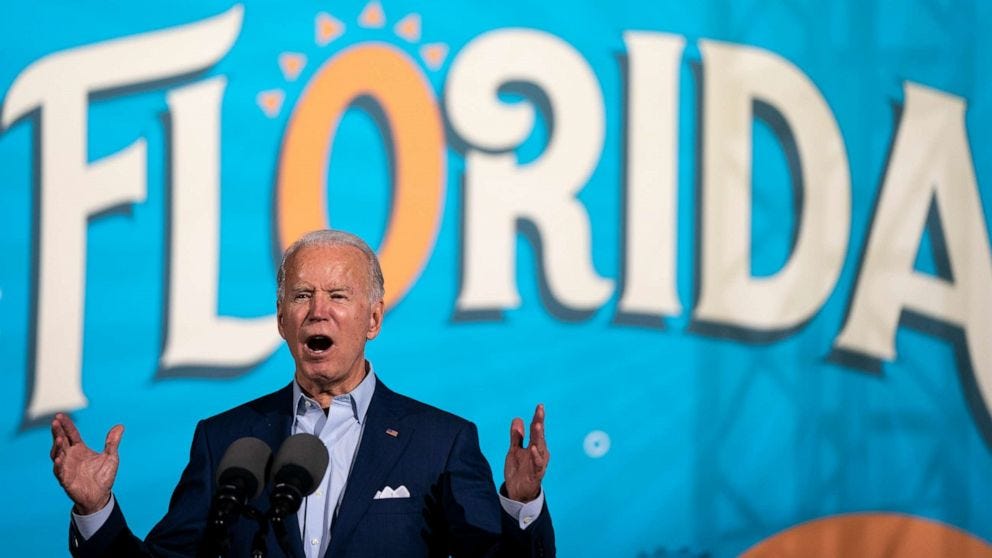
Florida is as red as it has been in a long time. The 2020 Presidential election saw the sunshine state give runner-up former President Donald Trump 51.2% of the vote, the highest share for a Republican since former President George W. Bush’s 2004 reelection, where he raked up 52.1%. The 2022 mid-terms did not see a national ‘red wave’ as many pundits predicted for Congress, but Florida certainly did. 20 out of 28 open House seats were usurped by Republicans and Senator Marco Rubio and Governor Ron DeSantis easily clinched reelection in their respective posts. Florida is a vast state, but attention is usually drawn to Miami-Dade County as a signifier of political tailwinds and the 2020 Presidential Election started to redden the blue hue of the county. 2016 Democratic Presidential nominee Hillary Clinton easily won the densely populated area with 63.7% of the vote; Biden only received 53.4% of the same vote in 2020.
So, Florida seems like a lost cause for President Biden to try to campaign for, right? Well, Biden raised millions of dollars in a fundraising event in Miami in January. Additionally, Vice President Kamala Harris and Second Gentleman Douglas Emhoff just opened up ‘Latinos con Biden-Harris,’ a Hispanic voter outreach initiative in a state that wields a majority-minority population dominated by Latino and Hispanic residents. And the Biden-Harris campaign quite explicitly sees the state as “winnable.” What gives then?
While many are focused on the names that will be on November’s ballots, the down-ballot referendums are what could be contributing to the Biden-Harris campaign’s line of thinking with Florida. The Florida Supreme Court decided on April 1 that referendums concerning abortion protections and marijuana-usage are now allowed to be placed on November ballots.
Down-ballot voting has historically been critical in determining voting trends in U.S. elections. They often force voters to consider their socio-economic views in coalition with the people who they are choosing to represent them. And with abortion and marijuana-usage, two issues that particularly invigorate progressive voters, the Biden-Harris campaign may be hoping for a sort of coattail effect that sways them away from Republican opponents, and ideally Donald Trump.
Every abortion referendum that has been put on state ballots since 2022 have resulted in a victory for the pro-choice side, even in Republican or swing states. Every single marijuana legalization initiative or referendum has passed in favor of pro-marijuana proponents since 2012; the most recent of which is in swing state Ohio, where it passed with over 57% in favor of legalization. Ohio is a state with MAGA minions like Senator J.D. Vance, Representative Jim Jordan and 2024 Senate nominee Bernie Moreno, and voters still felt compelled by their interest in civil liberties to take a majority progressive stance on an issue like marijuana. What’s even more notable about the Ohio vote is its turnout; it brought out almost 4 million voters. That is around three quarters of the voting numbers for the 2020 Presidential Election. If Biden is counting on this kind of an excitable demographic of individuality-concerned constituents, that is exactly what Florida might deliver him.
Marijuana-use has consensus support by self-identified liberals and Democrats and even over half of conservatives and Republicans support its legalization. Support for marijuana legalization also peaks in an important age demographic for the Biden-Harris campaign, those aged 18-34, at 79%. Support dwindles as cohorts of respondents increase in age, but the issue’s younger skew might help with youth skepticism of Biden in light of the Zoomer backlash toward his approach to the Israel-Hamas War.
Similarly important is how 56% of adult Hispanic voters support its legalization and a combined 84% of Hispanic voters aged 75 and older support either medical or recreational use of the drug. There are around a fifth of Florida voters that are Hispanic and Biden hopes to persuade them with this type of legal protection.
With abortion, 12% of voters say that it is their most important issue when considering who to vote for later this year. That share increases to 19% for women in states with abortion bans. DeSantis may have handed the Florida GOP a poison pill with his abortion efforts, as even though the Florida Supreme Court allowed its states voters to decide on the issue in November, they also upheld DeSantis’ 6-week ban in the meantime. While it is a victory for the Florida Governor on a short-term legislative level, it will be interesting to see if younger voters and women continue to show up in considerable numbers to vote for their individual rights and then cast a Democratic vote in protest of these Republican efforts. More than this though, while DeSantis’ bans were muddled with appeals, Florida became an abortion safe-haven for those in highly restrictive sun-belt states. Could Desantis have actually incited an ever larger coalition of pro-choice voters along the geopolitical spectrum than expected?
The trickle-down effect of down-ballots is not a sure-fire thing for Biden and Democrats to rely on though. According to the U.S. Vote Foundation:
“In a typical presidential election year, when barely 50 percent of eligible voters cast a ballot, a third or more of those voting don’t bother to fill out the entire ballot.”
Still, with Florida, Biden understands that he may not be able to get Trump voters to like him more, but these referendums may just get them to like Republicans less.