The Iron Claw (2023) film review & summary
RATING: STRONG 3/10
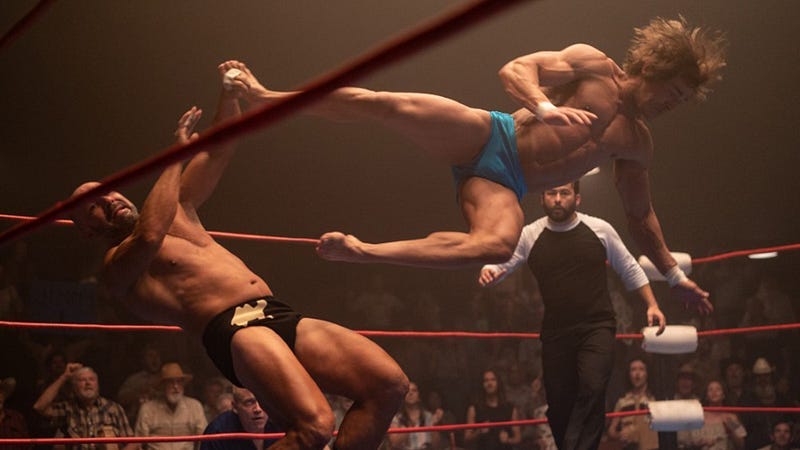
The Iron Claw (2023) is as bloated with blunt expository imagery and unnecessary melodrama as Kevin Von Erich’s (Zac Efron) swollen body. The trailers for this film promised what the A24 connotation is often expected to deliver: cinema that is too emotionally challenging for the informal movie-goer, but accessible enough for most to appreciate the presentation on its surface level. Instead, writer-director Sean Durkin falls into the box-office biopic trap of a preconceived story with too many juicy details and intricacies to properly be conveyed through the film’s muted tone and reluctance to attempt sincere eccentricity.
This eccentricity is fully realized in the film’s opening sequence though, where the superimposition of Fritz Von Erich’s (Holt McCallany) raw ferocity atop of the prestigious Texas World Class Wrestling ring’s empty carcass showcases how a simple physical setting can quite literally make these men into superstars. This is emphasized by the spotlight that identifies the ring, but leaves the empty bleachers in the dark, further symbolizing the ring as a vacuum for wrestler’s double lives to take form, although they cease to exist the moment they leave the stage. These subtle nuances are upheld through Kevin’s introduction; the opening shot displays his ballooning abdomen as he rises out of bed in his tighty-whities. Durkin may have intended for the audience to merely be in awe of the awesomeness of Kevin’s physique, but this subversive preface introduces the theme of arrested development that Fritz has sentenced his man-children to, but is never tastefully expanded on again throughout the film.
Kevin’s physicality leaves nothing to be desired, we see him sprinting through greens like an animal, eating meals like he is perpetually malnourished and forcefully domineering over opponents with a might that is unrivaled by his sibling counterparts. Efron may as well be deformed when comparing his appearance to his boyish looks of his High School Musical era, but his performance is feeble in the moments where he is required to be strong simply through his character’s soft-spoken nature. Listening to Kevin’s delivery, it is easy to sense the moments that are supposed to be heightened, somber, angry, but Efron’s candor is consistently monotone to the extent that his sheer brawn is the most dynamic aspect of his depiction.
Durkin’s screenplay and dialogue does little to assist Efron and the rest of the cast in their endeavors to fully explore the nuances of their characters though. Kerry Von Erich (Jeremy Allen White) is likely the most apparent victim of this. Kerry is a crucial embodiment of the so-called ‘Von-Erich curse,’ who is doomed to be Fritz’s next project after his Olympics debut is ripped away from him. Durkin ineffectively plants Kerry into the story, as he does with David Von Erich (Harris Dickerson) and Mike Von Erich (Stanley Simons), to be convenient tools to expedite the obvious and inevitable downfall of the Von Erich nuclear unit. Mike, David and Kerry are objectified by Durkin as B-plots to advance the primary dynamic between his choices of protagonist, Kevin, and antagonist, Fritz. Rather than deeming it worthy to uncover how Fritz’s incessant attempts to pit the boys against each other for his love and praise through extensive scenes of dialogue, The Iron Claw is content to let the weak symbolism do the talking. This is apparent in the pivotal moment where the audience is supposed to understand through the first appearance of a needle– albeit not subtly –that the Von Erich trio will go to any lengths to please their father, even at the expense of their own health. Rather than allowing the characters’ sorrow and internal struggles communicate where the story is at in its narrative arc, scenes like this show how the film is keen on spoon-feeding the audience with visual cues and not character development. Durkin takes the refrain “show not tell” too literally in moments like this.
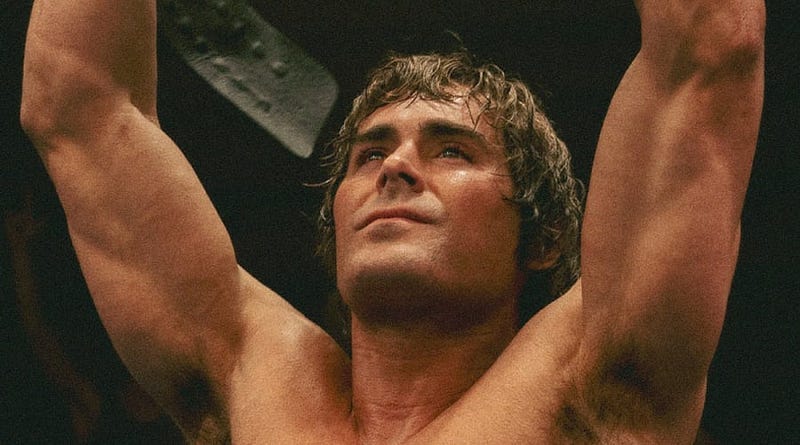
The film commits its aesthetic to honing the television presentation, performative cadence and theatrics of early primetime wrestling. This is furthered by its graininess and warm saturated colors. These touches feel like fluff though, as it is not only impossible to truly connect to the characters when their internal monologues are constantly neglected or exploited. The latter is egregiously apparent for Kerry’s eventual demise to the ‘curse,’ as he is only reintroduced towards the end of the film for the sake of concluding his narrative arc.
Films like Darren Aronofsky’s The Wrestler (2008) and Martin Scorsese’s Raging Bull (1980) have provided the framework for how obsessive juggernauts in their field of work can be brought down by, and can bring down, the social relations around them, but The Iron Claw chooses to carve out its own path for worse. There are no true highs for the audience to understand how low the Von Erichs bottomed out to. The film has the downfall mindset of the aforementioned cinematic efforts, but there is never a true comprehension from either the characters or Durkin on why the Von Erich zeitgeist was destined to collapse.