There are no Gen Z coming-of-age films
Why can't we get our own Ferris Bueller's Day Off?

Every generation has had zeitgeist-defining films that capture youth culture dating back to the adults that came out of the Korean War. Baby Boomers had The Graduate (1967) and American Graffiti (1973) that defined a newfound sexual promiscuity and social experimentation that was previously restricted by the duties of consecutive wars. Generation X had films such as Reality Bites (1994), Dazed and Confused (1993) and pretty much anything by John Hughes to refer to as sources of hope that they were not too late to enjoy the splendor of Ronald Reagan’s hyperactive free-market economy. Millennials became the first adults of the 2000s and welcomed the irreverent tone of films like Superbad (2007), Napoleon Dynamite (2004) and Juno (2007) to embody the absurdity of understanding a post-Y2K and technology-obsessed new world order. Generation Z, otherwise known as Zoomers, has concluded and there is no concise cinematic representation of what this era of new adults and teenagers has experienced.
Zoomers date back to 1997 and have been born as recently as 2012. These two ends of the spectrum are so stark in their surrounding societal environments that they can hardly be compared. Juxtapose this to Boomers who– young and old –were all directly or indirectly affected by preceding back-to-back-to-back wars; Xers that came of age in the post-Vietnam War decades of hippy and drifter retrospection that inspired the desire, and inevitable reluctance, toward a linear education and career; Millennials that grew up through the dot-com bubble burst and saw the subsequent aspirations and limitations of the infinite Internet. But Zoomers’ chronology is more discombobulated.
Those born in 1997-2005 experienced America’s last childhood before an explosion of social media, which was conveniently marked by the debuts of MySpace and Facebook in 2003 and 2004 respectively. Now adults, these Zoomers still knew a time where it was not a given to provide children with mobile phones, where you still had to remember what time your favorite television shows came on because streaming could not make it as readily accessible and where technology in education was a gimmicky novelty. Then there are those born in 2006-2009 who experienced the bulk of their formative years within the pandemic and essentially became teenagers online and inside. Lastly, those who were born in 2010-2012 had their rudimentary education shaped by COVID-19 and digital learning and now have to come of age ‘irl’ when many had likely become accustomed to the detached sociological connotation of remote engagement and relationships.
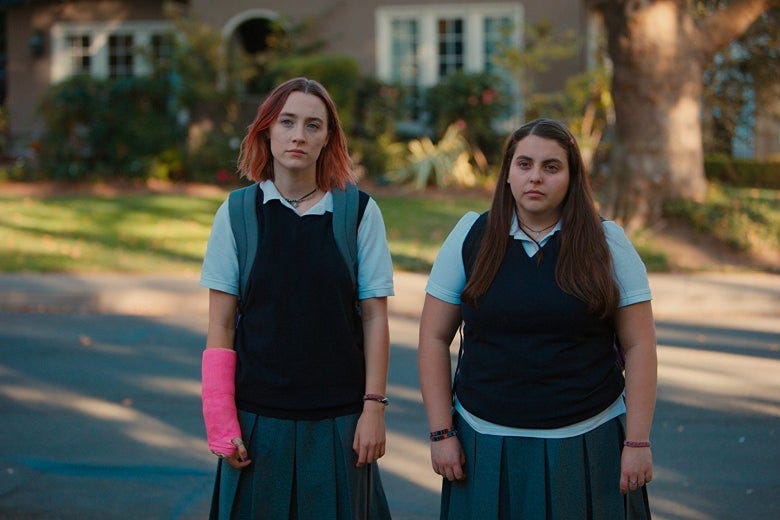
It is difficult to creatively encapsulate Zoomers in one fell swoop, but many directors either have not tried or their works have already become outdated as a natural result of the pandemic and the unprecedented boom in social media usage. Some may point to films like Yes, God, Yes (2019) and more prominently Lady Bird (2017) as indicators of how children who grew up with the Internet and endless information have become more independent-minded and reluctant to accept authority because of it. This in itself is me grasping for straws because of how both stories are situated in early 2000s America, which is indicative of the lack of more contemporarily-oriented young-adult films. But they also miss the primary component of how this information is distributed or accepted, which is usually through social media or online parasocial relationships where disaffection from their close social network has led them down a path of trusting a stranger that seems infallible, merely because they are contrarian to societal standards or there has not been enough information to say otherwise. It is not to be disregarded how pivotal platforms like YouTube, TikTok or Instagram have been in making impressionable young viewers think that popularity equals peer affirmation and consequently pseudo-validation of these ideas (i.e. Joe Rogan, Jordan Peterson). Films like Lady Bird could be applicable to the older end of Gen Z, but it lacks emphasis on how important social groupthink is in the youth development of the younger end.
I consider myself knowledgeable enough in film to name some examples off the top of my head that would define my own generation, I am a member of it for goodness sake. But every 21st-century coming-of-age film I thought of seemed to focus on general undertones of becoming an adult, but not the overtones of what it means to be a Zoomer. There are shows like Euphoria that depict how a millennial creative can grossly exaggerate the most depraved segments of Gen Z as if its our silent majority. Then there are films like Boyhood (2014) and Inside Out (2015) that are too substantively expansive to nail down a cohesive through-line for Gen Z. But films like North Hollywood (2021) and Netflix throwaways like The Kissing Booth (2018) and To All The Boys I’ve Loved Before (2018) also do not take a serious look at the coming-of-age experience and opt for a caricature in their own respective manners. Feeling defeated and embarrassed to call myself a cinephile, I turned to Zoomers’ greatest resource and worst plague: the Internet and its thought-defeating top-(insert number here) lists.

What became clear in all of these ‘definitive’ Zoomer coming-of-age cinematic universes is that they seemed to all coincide with the Marvel Cinematic Universe. Ranker lists the MCU reboot of Spiderman within its “The 25+ Best Movies About Generation Z (So Far), Ranked,” MovieWeb does the same with their ranking. Beyond these two examples, you’d be hard-pressed to find any real list that names films about the Gen Z experience, and not those that simply feature a Gen Z actor. Franchises and reboots have become more prominent in Gen Z’s cinematic era compared to preceding generations’ and that is a claim that is easy to prove. Previous generations’ blockbuster stalwarts like Jurassic Park, Planet of the Apes and even Top Gun have been retrofitted to appeal to Gen Z. More than this though, superhero films have been produced at breakneck pace– although to a less profitable degree recently —providing independent filmmakers who are usually responsible for speaking for the unspoken with little airspace to breathe in a cinematic yearly schedule filled with the equivalent of IPO films. That being said, mega-franchises like Jaws and Die Hard existed in prior generations, where coming-of-age films were still able to carve out a niche in the cultural zeitgeist in a way that has not occurred for Gen Z. And now that we are over a decade removed from the end of the Zoomer birth cycle, it is a glaring omission that still has not been resolved.
*THIS ARTICLE IS PRIMARILY FOCUSED ON AMERICAN CINEMA*